Japanese Railway Labour Quotas
The Narrow Road to the Deep NorthJapanese Railway Labour Quotas were imposed production targets for prisoners of war building the Death Railway. They translated an engineering schedule into a daily demand on a weakened workforce: when a strong prisoner exceeded his target, Japanese engineers could raise the quota for everyone. Under The Speedo, the system accelerated further, as delays prompted longer shifts and more pressure. The rule’s significance lies in this conversion of progress into bodily cost, and in the way its arithmetic shaped both camp authority and the choices available to Dorrigo Evans.
Engineering Targets and Labour
The quotas served a railway project driven by military urgency. Japanese leaders sought a land route through Burma to supply their forces and interrupt Allied support to China, but lacked the money, machinery, and time to build the necessary line by ordinary means. The planned railway was marked by surveyors’ pegs along a route of 415 kilometres, running from north of Bangkok toward Burma. The scale of the plan made human labour central to the project: prisoners were assigned to clear jungle, break rock, move earth, and carry sleepers and rails.
The engineering demands could change even after work was underway. When Major Nakamura received revised instructions from the Railway Command Group, a cutting already half-completed was to be enlarged by a third to address gradient problems in the next section. That alteration required another 3,000 cubic metres of rock to be removed. Nakamura noted that the prisoners had to break rock by hand with hammers and chisels, while the camp lacked enough tools and fuel to keep the chisels sharp. The episode shows the distance between the railway’s technical specifications and the means available to meet them: a revised measurement became a new labour requirement, regardless of the shortage of equipment.
Individual Output Becomes the Standard
The quota system’s pressure could spread from one man’s performance to the whole work party. Tiny Middleton made holes in rock by striking a steel bar with a sledgehammer while Darky Gardiner held and turned the bar. Tiny took pride in finishing his assigned work early. To him, doing more than required was a personal contest with his captors; in practice, each new performance could give the engineers grounds to demand the same pace from others.
The targets rose from one metre of work a day to two and then three. Tiny continued to meet them, although many of the other prisoners were ill, underfed, or trying to conserve their limited strength. Sheephead Morton objected that Tiny’s record-setting helped establish demands that the rest of the men would have to meet. The system therefore made exceptional output punitive in its effects: a measure of one worker’s capacity became a benchmark imposed on workers with very different health and strength.
This conflict was not simply about whether a man worked hard. Tiny understood his speed as a way to assert himself, but the quota structure allowed the Japanese engineers to turn that effort into a collective obligation. Darky, who worked beside him, came to resent the consequences for the other prisoners. The episode makes the quota more than a neutral unit of production. Its force depended on who set the target, whose performance counted as the norm, and who bore the cost when the norm rose.
The Speedo and Intensified Work
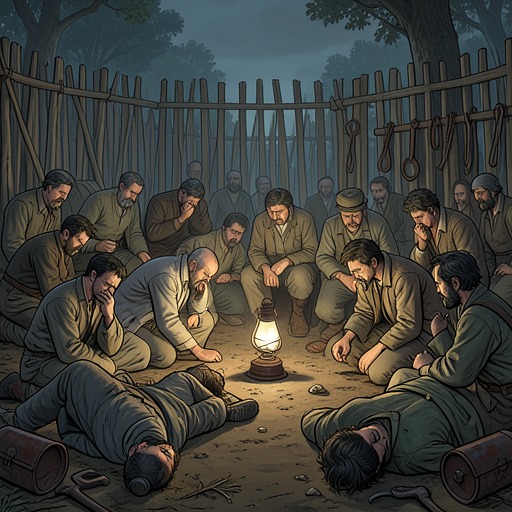
As the POWs fell behind the Japanese schedules, the demands intensified. The Speedo brought more pressure to work harder and longer, alongside reduced food and further beatings. Work did not necessarily end when the prisoners returned exhausted to their sleeping platforms: one night, they were ordered back to the cutting, beginning night shifts as well as the daytime work.
The cutting itself was a substantial engineering site, six metres wide, seven metres deep, and half a kilometre long. Prisoners worked there with hand tools, including steel bars and hammers. Under the added night work, the timetable increasingly governed the camp’s hours as well as its output. The escalation was not presented as a separate system from the quotas; it followed from the pressure to meet schedules that the available labour and equipment could not reliably satisfy.
Tiny’s experience shows how even an especially strong worker could not sustain the accelerated pace indefinitely. On the first night shift he struggled to use the sledgehammer, then let it fall and collapsed. His earlier ability to exceed the target had helped make higher output seem attainable, but the new schedule exposed the limits of that assumption. The quota system could demand more from bodies without making those bodies capable of delivering it.
Negotiation and Medical Arithmetic
Dorrigo Evans encountered the labour demand as both the prisoners’ commanding officer and their senior medical officer. During one selection, he reported that the camp held 838 POWs. Of these, 67 had cholera, 179 were in hospital with severe illness, and 167 could perform only light duties; another 62 sick men were present at the count. Dorrigo calculated that 363 men were fit for railway work. Major Nakamura demanded 500, and Lieutenant Fukuhara conveyed that demand while also attributing the illness to insufficient cleanliness and will.
Dorrigo continued to negotiate despite knowing that medical categories could not shield the prisoners from the requirement. He proposed 400 men, explaining that beyond that number the work would cause further deaths and leave fewer men able to return to duty after recovering. Nakamura insisted on a higher figure. During the confrontation, he struck Dorrigo as the dispute continued. Dorrigo’s calculations shifted as he considered whether some hospital patients might manage very light duties and whether some men on light duties could be added to the work parties. He estimated a possible maximum of 406, but knew it would not meet Nakamura’s demand.
The final figure was 429. Dorrigo had begun by reporting 363 men fit for work and had argued that 400 was the greatest number he could provide; the settlement therefore did not represent an agreement on medical fitness. It was a compromise made under coercive authority, with the additional workers drawn from men whose illness made the assignment dangerous. For Dorrigo, deciding whom to include meant weighing degrees of sickness against the likelihood that a man would survive the work. The recurring negotiation turned camp medicine into a form of triage under conditions the Japanese demands controlled.
Consequences and Significance
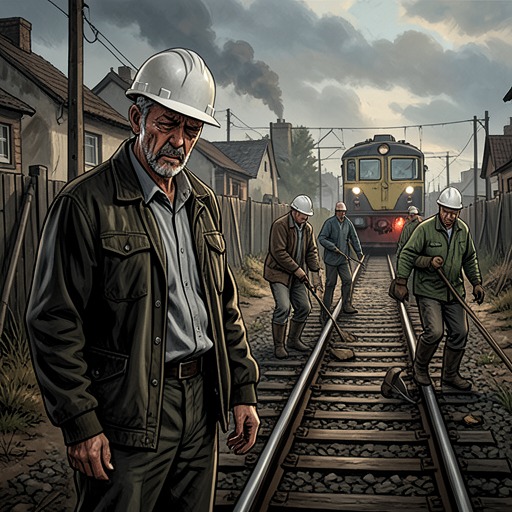
The railway’s completion makes visible the scale of the labour system behind the targets. On 25 October 1943, the locomotive C 5631 travelled the length of the completed Death Railway, carrying Japanese and Thai dignitaries. Among the dead were Australians who had been compelled to build it; the novel describes the remains of one in three of the Australians sent to the railway as lying along its route. Allied prisoners were only part of the workforce: roughly 60,000 Allied POWs laboured on the project alongside a much larger population of Asian labourers, whose total deaths remain uncertain.
The quotas thus register a larger failure of measurement. Railway plans assigned lengths, depths, gradients, and deadlines, while camp officers counted the living and sorted them by apparent ability to work. Yet the people counted could not be reduced to reliable units of output: illness changed who could work from day to day, and an imposed increase in the target could magnify the danger to everyone. Dorrigo’s final calculations did not end that danger; each negotiation merely determined how it would be distributed.
After the war, the railway lost its military purpose and support. It was abandoned, dismantled, and gradually altered by weather and vegetation. Its physical remains and the memorial display of C 5631 persist in contrast with the incomplete record of those who died building it. The quota system is therefore part of the novel’s account of infrastructure as both a material achievement and an instrument of imperial violence: a line measured out on the ground, built to a schedule, and ultimately unable to preserve either its purpose or the lives spent making it.